

Scaling education for 45k students
Kaplan Professional trains 45,000+ people a year. We helped bring three sites together into one scalable platform, built for speed and clarity.
View full projectHow Huntsman Security unified sales and marketing across the UK and Australia
Huntsman Security sells visibility and trust to enterprise and government security buyers who cannot afford to leave their cyber security to chance. Its SIEM and threat-exposure management products exist so security teams can see what is happening across their estate, and rely on it.
The Ops side of the business wanted better visibility of its customers and markets. The legacy platform running sales and marketing across the UK and Australia had become something the team could no longer trust, just at a point where transparency was key for the success of go-to-market efforts.
Issues were starting to emerge:
Surrounding these core problems were other issues:
The resulting system very much characterised a disaggregated set of related but independent processes. Some users took the better part of a year to become comfortable with the system, while others kept their own spreadsheets to work around it. For a business trying to manage a single operation across two geographies, the problem was one of structure rather than user training.
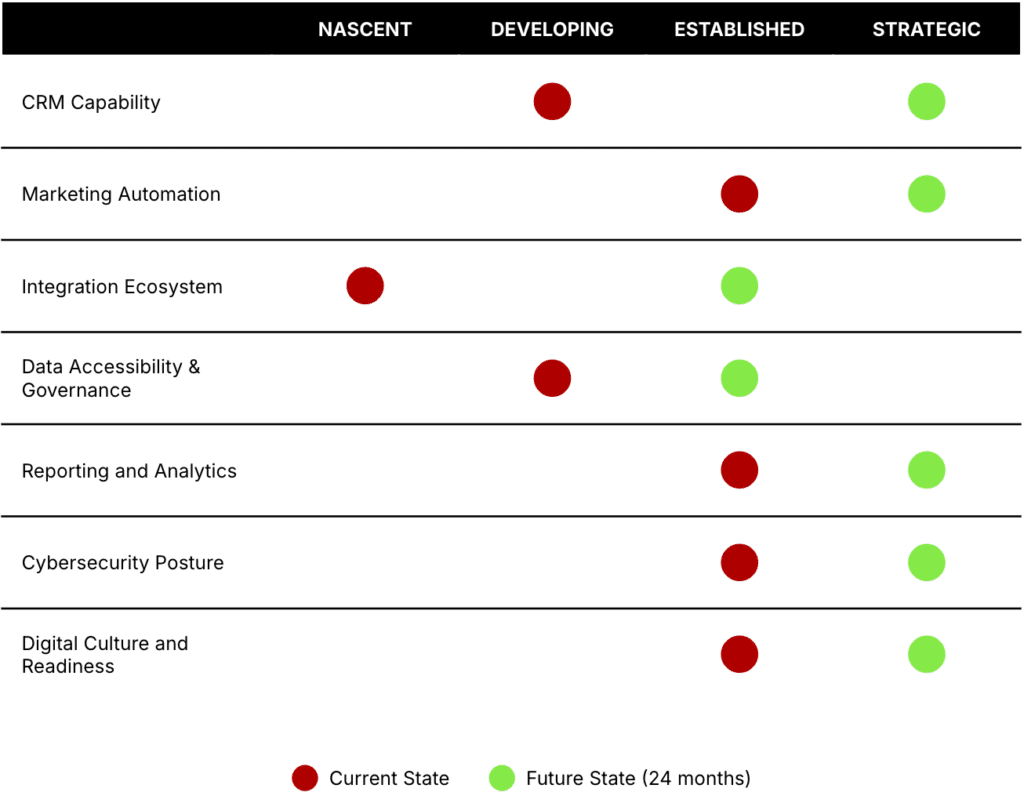
The project opened with a structured discovery phase with interviews across sales, marketing, and leadership. The outputs were analysed alongside a full audit of the existing CRM and automation database.
The audit quantified exactly what the business was carrying:
Every component was assessed and marked as to whether it should be migrated, rebuilt, or retired. Much was marked for rebuild or retirement, and only components with continuing strategic value were carried forward.
Interviews surfaced four recurring issues across the teams:
Fly ensures this kind of synthesis becomes the brief for what a new platform needs to achieve. Generic migration checklists usually fail to capture, address, and guide the nuances required for successful platform crossovers, particularly beyond immediate outputs.
Huntsman needed a single trusted system of record, native reporting that did not rely on manual exports. It needed to integrate with the tools sales and marketing already used, and would scale without becoming over-engineered for a team of its size. HubSpot Marketing Hub and Sales Hub at Professional tier addressed each of those requirements directly.
With HubSpot confirmed, the migration was scoped and delivered as a structured, phased project targeting go-live in Q4 2025.
The pipelines were rebuilt from the ground up. The two existing disconnected pipelines became a single 5 stage sales pipeline (Qualification, Demo, Negotiation and Nurture, Verbal/Written Win, Purchase Order) and an accompanying multi-stage renewals pipeline.
Each stage was mapped explicitly to the old structure so that historical deals were routed accurately with nothing lost in translation. Tender-response deals, which follow a different cycle and carry different expectations on time to close were separately tagged for filtering and reporting within a single CRM system.
Contact, company, and deal data moved in controlled test batches before any live data was touched, with deduplication, cleansing, and validation built into every stage. Custom fields preserved the original CRM identifiers and segmentation logic, so the team could audit the migration and cross-reference historical records after cutover.
Around 9,000 contact notes, 336 deal notes, and 288 company notes were matched and imported against the correct records. After deduplication and a deliberate decision to exclude a decade of legacy data the records were curated for effective operations.
Enrichment was configured to run automatically against new contacts coming through the website, correcting the accumulation of stale data in the old system. Lead status and lifecycle stage rules were rebuilt to reflect how a contact moves from lead to opportunity to customer, replacing a set of labels that had been inconsistently used for years.
A dedicated training programme covering navigation, reporting, and automation was built and delivered alongside the technical migration, that addressed the gaps of the earlier solution.
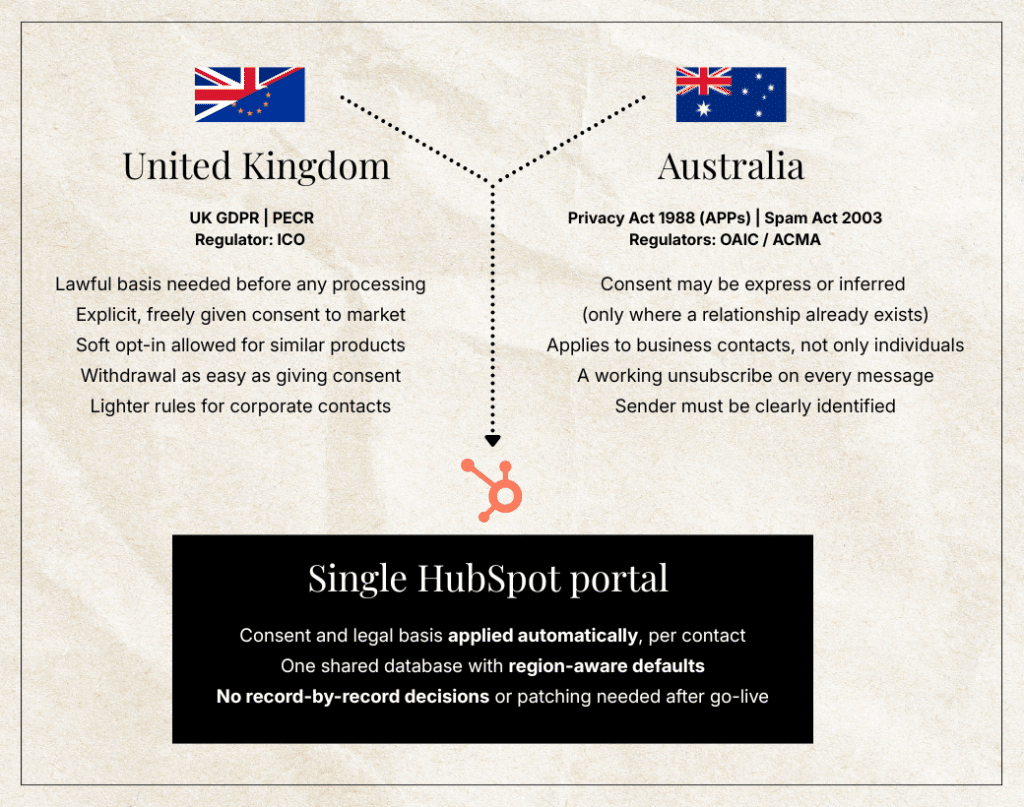
Huntsman runs one commercial operation across Australia and the UK, which means one system carrying two different sets of materially different regulatory obligations at once.
The build handles this behind the scenes which means compliance delays to internal workflows are avoided. Consent and legal basis for processing are applied automatically and correctly for each contact, without anyone having to make individual adjustments record by record. A UK audience under GDPR and an Australian audience under its own rules are served from one shared database, not two separated CRM systems running different rules.
The same care runs through the rest of the setup, so day-to-day defaults suit an Australian-led business trading into other markets. This meant none of it was left for the Huntsman team to patch together after go-live.
Huntsman moved from a platform nobody trusted to one built around how the business actually sells, with a single pipeline both sales and marketing can trust. Reporting no longer depends on a manual export or a separately maintained dashboard. Renewal workflows run on their own, and the data model treats Australia and the UK as one operation rather than two workarounds trying not to collide.
Additional improvements achieved include:
Fly continues to work with Huntsman on an ongoing basis, extending automation, building out the website’s content architecture, to reinforce the adoption of the new cost effective CRM system.
Explore our latest case studies
Kaplan Professional trains 45,000+ people a year. We helped bring three sites together into one scalable platform, built for speed and clarity.
View full project
A smoother journey for 6,500 people – with less admin, faster delivery, and 30+ hours saved every month.
View full project
We helped Reco scale their brand, systems and sales – delivering a 22% CAGR and saving 331 hours a year through automation.
View full project